Snowflake Account Architecture for Multi-Tenant B2B SaaS
Each model trades operational simplicity for data isolation and compliance risk differently.
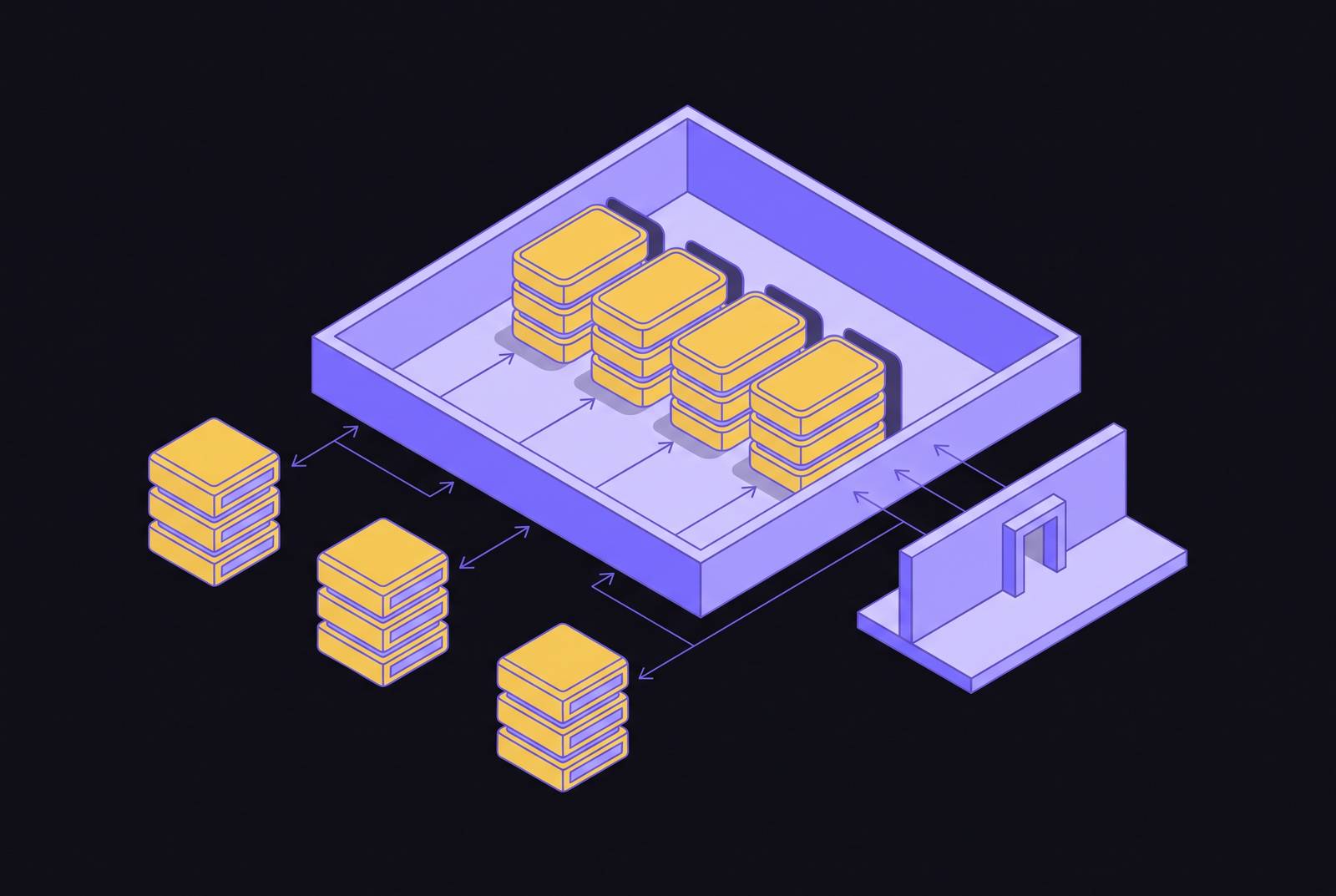
Snowflake gives every B2B SaaS team building on it a real choice: put all your tenants in one shared set of tables, split them into their own schemas, or hand each one a fully separate account. This is not a technical footnote. It determines how a security incident spreads, what an enterprise procurement team will sign off on, and how much a data platform team spends the next two years babysitting infrastructure instead of shipping features.
Snowflake's flexibility creates a real architectural decision for B2B SaaS teams
Snowflake separates storage from compute and runs on AWS, Azure, and Google Cloud, handling SQL analytics, data engineering, machine learning, and now agentic AI workloads inside one platform. It serves more than 10,000 customers and has moved well past its original "cloud data warehouse" label; Snowflake now calls itself the AI Data Cloud, and the product surface backs that up.
A single Snowflake account lives in one region, but nothing stops a team from spinning up as many accounts as it wants, across more than 35 regions and across all three major clouds. That freedom sounds like a convenience. In practice, it's a decision forced onto every SaaS team the moment they onboard a second customer, because isolation level in Snowflake is not something the platform decides for you. It's a design choice, made once and lived with for years.
The benefits and hidden risks of the shared-table model (MTT)
In a multi-tenant table (MTT) setup, every customer's rows sit in the same tables, distinguished only by a tenant_id column. The application layer, not the database, keeps track of which user belongs to which tenant. Isolation happens at query time through row access policies, and Snowflake's CURRENT_ACCOUNT() function can be combined with those policies to build something close to a self-managing multi-tenant system, one where the platform itself enforces who sees what row.
There are four common ways to isolate data in this model before handing it to a client. Filtering through secure views is dynamic and supports joins across base tables. Filtering through row access policies, applied directly to base tables or views, is also dynamic and widely used. Persistent methods pre-populate tenant-specific tables before sharing, which works but produces a separate listing per customer instead of one shared listing serving many. That distinction between non-persistent and persistent sharing methods ends up mattering a lot once a platform team is managing dozens or hundreds of tenants.
The upside of MTT is real and it's not small: one dbt repository, one set of pipelines, one CI/CD flow. Of the three models, it carries the lowest operational overhead by a wide margin. A row access policy bug in this model isn't a contained incident, it's a platform-wide one. Every tenant's data sits one misconfigured policy away from every other tenant's data. A row access policy bug in this model isn't a contained incident, it's a platform-wide one.
Schema-per-tenant isolation for growth-stage SaaS teams
Schema-per-tenant (OPT) splits the difference. Each tenant gets a dedicated schema inside one shared database, and isolation runs on schema-level role-based access control instead of row filters. You're now dealing with physically separate objects per tenant, a shared table with a WHERE clause no longer standing between customers.
A typical build includes one platform database (something like SAAS_PLATFORM_DB), a platform admin role, an app service role, a shared warehouse, and an audit schema holding a tenant registry table. New tenants get provisioned through a stored procedure, commonly named something like PROVISION_TENANT, that creates the schema, builds the standard set of tables, sets up tenant-specific roles, and grants the right permissions automatically. That stored procedure is what makes OPT survivable at scale. Schema migrations run against a template and roll out per-tenant through automation, not through someone manually re-running schema changes a hundred times by hand.
The isolation logic here is straightforward to explain to a security reviewer, which is part of why growth-stage teams gravitate toward it. Because tenants are structurally separated by schema, a misconfiguration is contained within the boundaries of that design rather than spanning the entire platform.
When account-per-tenant isolation is the only defensible answer
Account-per-tenant (APT) goes all the way: each customer gets a fully separate Snowflake account, with its own dbt repo, its own CI/CD pipeline, and its own cloud integrations. There's no shared database, no shared schema, no shared anything at the platform level. It is a hard boundary, full stop.
The logic behind APT is simple to state and hard to argue with. If one customer's data gets corrupted, only that customer's database is affected. There's no blast radius reaching into anyone else's environment. That property is what makes APT the standard answer for regulated industries, high-sensitivity clients, enterprise contracts with data residency clauses, and consulting or professional-services engagements where the contract itself demands separation.
Sometimes the decision isn't even really a decision. One practitioner working in this space described having multiple Snowflake accounts host customer data as "a contractual requirement rather than having multiple databases inside of the same Snowflake account." Engineering reasons rarely drive the choice of APT. It's chosen because a procurement or legal team wrote it into the contract, and the architecture has to comply.
Compute isolation as a cross-cutting concern that all three models must address
Data isolation and compute isolation are two different problems, and Snowflake lets teams solve them independently. Virtual warehouses can be assigned per tenant regardless of which data model is in play, so a team running MTT or OPT can still hand its heaviest, most demanding tenant a dedicated warehouse without touching the underlying schema or table structure.
The real question every team has to answer, no matter which isolation model they picked, is whether any tenant is big enough or noisy enough to justify isolated compute. A hybrid approach, shared warehouses for most tenants and dedicated ones for a handful of heavy users, usually gets the best balance of cost against performance. Not every tenant earns a dedicated warehouse; most don't need one.
One optimization crosses all three models cleanly: partitioning tables by tenant ID or by time interval cuts down scan cost and speeds up queries at scale, regardless of whether those tenants live in shared tables, separate schemas, or separate accounts.
The isolation model's effect on data sharing with enterprise customers
For B2B data products selling into enterprise accounts, Snowflake Secure Data Sharing offers a delivery path that sidesteps the usual export-and-integrate cycle. A provider can give a customer a read-only share that lives inside the customer's own Snowflake account. No file exports, no API rate limits to manage, no integration project for the customer's engineering team to schedule and staff.
This doesn't make sense for consumer products, since consumers don't have Snowflake accounts sitting around waiting for a share. But for industry benchmarking data, supply chain data, and market intelligence products, sold specifically to companies that already run on Snowflake, it removes the need to build and maintain delivery infrastructure.
Providers can now share open table formats, specifically Apache Iceberg and Delta Lake, across regions and clouds without the pipeline complexity that used to require, and without the exponential per-query egress costs that used to come with cross-region sharing. Data held in a customer's own cloud storage, whether that's AWS S3, Azure Storage, or Google Cloud Storage, works under this model. Apache Iceberg tables managed by Snowflake's Horizon Catalog or by external catalogs like AWS Glue or Apache Polaris are supported, as are Delta Lake tables managed by external catalogs such as Databricks Unity Catalog or Hive Metastore. Snowflake has said its data sharing ecosystem is 2.5x the size of the nearest competing platform, a scale advantage that matters directly to any provider counting on customers already being present on the network.
The decision framework: matching isolation model to product context
Four dimensions decide which model fits: security isolation requirements, cost, how much operational overhead the team can actually absorb, and enterprise compliance demands. No single model wins across all four at once, so the decision comes down to which tradeoffs a given product can live with.
MTT makes sense with a large number of small tenants, no requirement for direct infrastructure access, and centralized governance that customers are comfortable with. It demands strict row-level security discipline, a testing setup that actually validates policies before they ship, and an honest acceptance that a policy bug has consequences for the whole platform, not just one account. Any customer asking for data residency, physical isolation, or their own Snowflake credentials disqualifies MTT immediately.
OPT tends to fit teams in the range of roughly 50 to 1,000 tenants, where structural isolation matters but a contractually separate account isn't on the table. It requires provisioning built around stored procedures, careful RBAC design from day one, and a plan for handling repo and CI/CD sprawl as the tenant count climbs. Contractual requirements for separate accounts, or regulated industries with hard boundary rules, rule OPT out.
APT is the right call below roughly 50 tenants, for customers in regulated industries, for contracts that mandate isolation outright, or for consulting and professional-services work where separation is the whole point of the engagement. It demands automation for schema migrations across accounts, per-account CI/CD pipelines, and a cost model that accounts for separate credit pools per tenant. Past roughly 200 tenants without serious investment in fleet-management tooling, APT stops being sustainable. Teams that try to scale it manually past that point face significant operational strain.
A white-label data connectivity layer's fit into each isolation model
Once the isolation model is locked in, the next question is how data actually moves into and out of Snowflake at the product level, and the isolation choice determines what that connectivity layer needs to do.
Under MTT, a single pipeline writes into shared tables, so the connectivity layer has to enforce tenant tagging at the point of ingest and must never let a row land without a valid tenant_id attached. A silent ingest failure here doesn't just lose data, it risks writing a row with no tenant boundary at all, which in a shared-table model is the failure mode the whole isolation strategy exists to prevent.
Sources
- Snowflake Architecture: Pick the Right Fit | Leolytix
- Building a Multi-Tenant SaaS platform on Snowflake
- Strategies for Multi-Tenant Data Sharing in Snowflake | by Jwala Vedantam | Snowflake Builders Blog: Data Engineers, App Developers, AI, & Data Science | Medium
- 🧊 Single vs. Multi-Tenancy in Snowflake: A Practical Breakdown for Data Architects | by Gautam Marya | Medium
- developers.snowflake.com
- blog.infostrux.com
- snowflake.com