Native App Framework vs Custom ETL for Enterprise Customer Data Delivery to Snowflake
Native apps keep data in-house; custom ETL trades control for reach.

Enterprise customer data export to Snowflake and Redshift without custom pipelines is a fit for managed or embedded integration platforms. The choice depends on which warehouses it serves, what the workload needs, who holds the data, and whether owning a pipeline helps the product compete.
The two architectural bets — compute moves to data, or data moves to compute
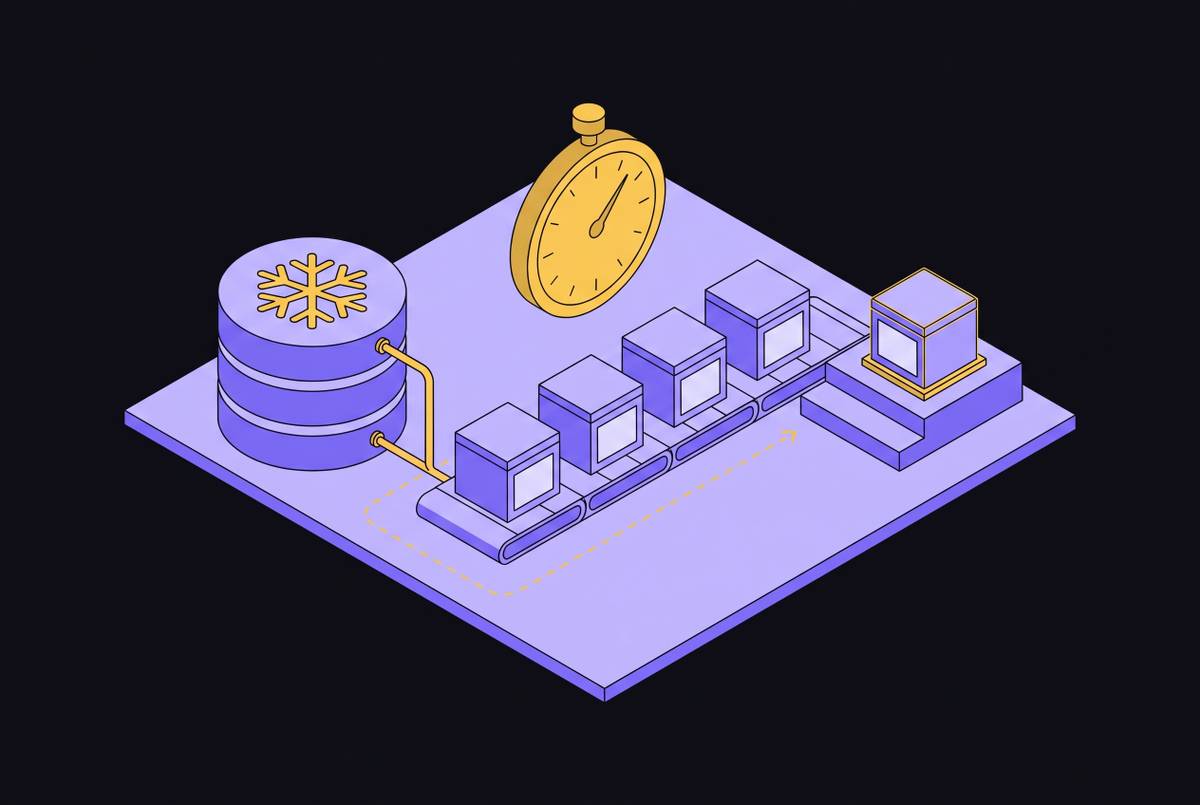
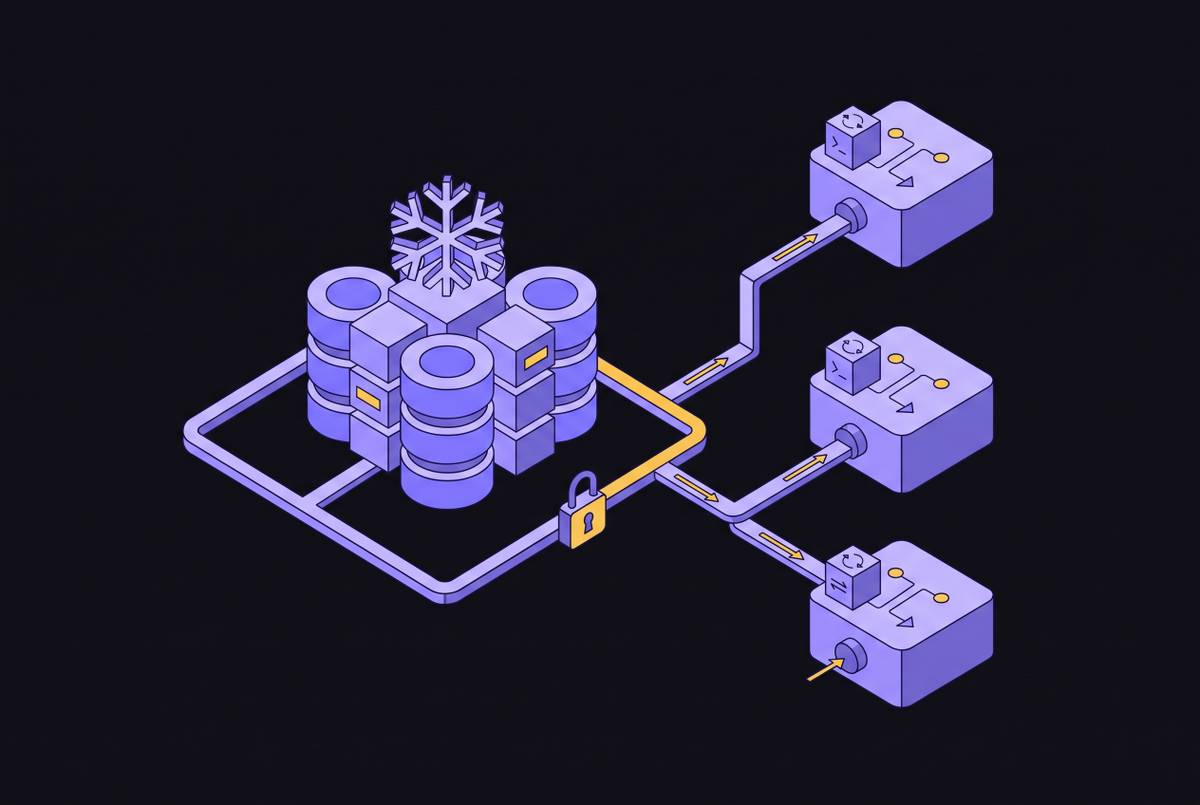
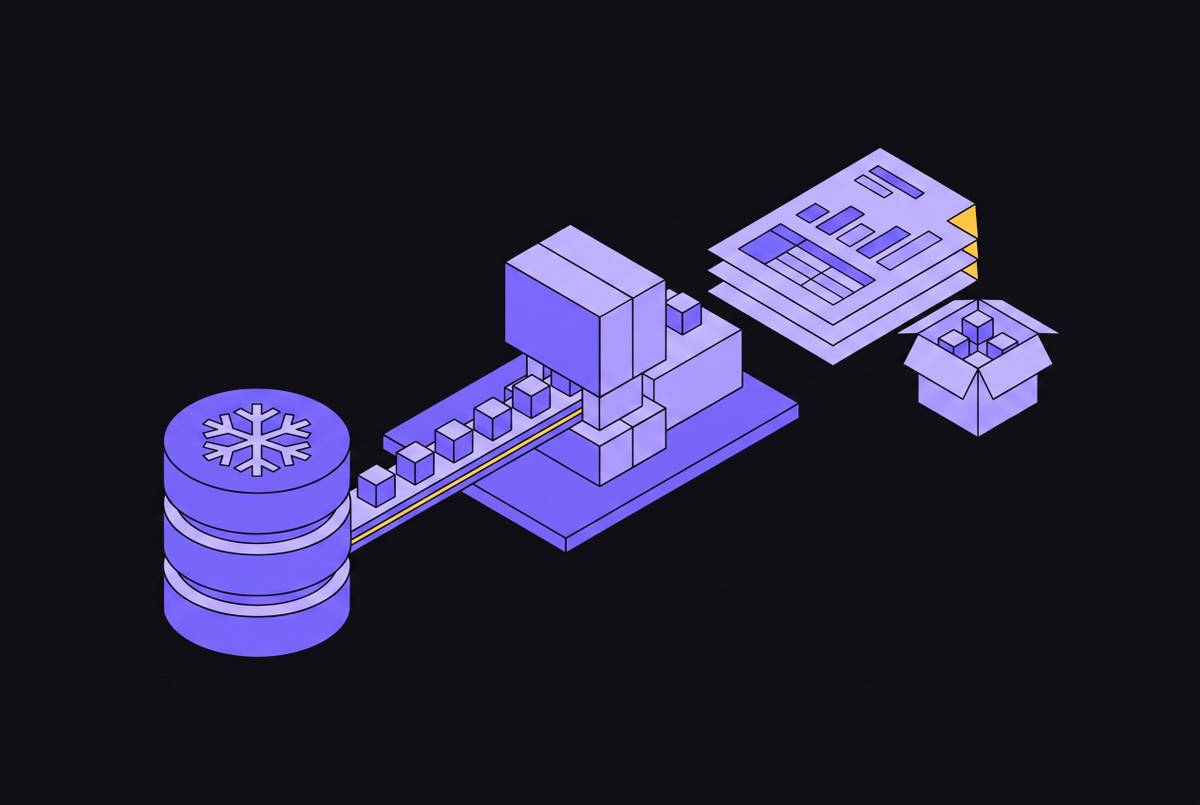
“Compute to data” describes the Native App Framework, while “data to compute” describes custom ETL. In the native model, a provider’s processing logic runs against data within the consumer’s Snowflake account. In custom ETL, data is extracted from source systems, transformed in transit or at rest, and loaded into the customer’s Snowflake environment. The pipeline’s compute runs outside the warehouse that receives the data. The direction determines custody, security boundaries, and the provider’s monetization options.
These are different responsibilities. A product that processes data already in a warehouse needs an execution environment, while one that exports source data needs a way to deliver it. FNU Aditya Ranjan’s comparative analysis concludes that none of the native integration patterns across AWS, Snowflake, or Databricks universally replaces general-purpose ETL. That distinction keeps a native application from being mistaken for a complete source-to-warehouse pipeline.
What the Native App Framework actually gives a provider — and what it withholds
The Native App Framework lets providers package processing logic with web-based interfaces for dashboards and human-approval workflows. Apps inherit the consumer’s existing Snowflake identity, access controls, lineage, and auditability. Distribution is part of the package. Providers can list apps on the Snowflake Marketplace, with billing handled by the platform. The central capability is in-house processing, where vendor IP runs on consumer data without extracting it.
That capability has a defined execution envelope. Procedure- and UDF-based features fit the framework’s evaluation criteria, while workloads requiring temporary tables or temporary stages for unpersisted intermediate results fall outside the supported pattern described here. Snowpark Container Services also provides a path for containerized applications. Its availability does not remove the need to evaluate intermediate-state requirements. Feature expressibility therefore requires examination of the actual workload as well as its programming language.
Deployment requirements impose a separate set of constraints. Customer coverage across AWS and Azure warrants caution, while coverage spanning AWS, Azure, and GCP raises stronger concerns because cloud support and private-connectivity configurations vary. Load balancing, failure recovery, replication, and government-region support require careful evaluation and may not be supportable. External app interaction is not categorically excluded. Inter-App Communication became generally available on April 28, 2026, so apps can interact with other providers’ Native Apps through provider-defined interfaces when the consumer explicitly authorizes it.
What does custom ETL actually cost, and where does that cost hide?
Custom ETL lets teams control transformation logic, scheduling, intermediate storage, and orchestration without the restrictions that the Native App Framework places on how they are built. Its reach also extends beyond Snowflake. A product team serving Redshift, BigQuery, and Databricks customers can build delivery paths for those destinations rather than limiting the product to one warehouse environment. That freedom is the principal technical benefit. It lets the pipeline follow customer requirements instead of fitting them into a warehouse-specific application model.
The visible investment is construction, but ownership begins at deployment. Getting even one source connector ready for production takes a lot of engineering work before ongoing maintenance starts. Each new source or destination adds another connector to own. This is connector sprawl, and it compounds. Schema drift handling, rate-limit management, and observability remain product-team responsibilities rather than disappearing when the initial export succeeds.
Choosing to build therefore means committing to the cost of keeping it running. Managed ETL changes that commitment through maintained connectors, configuration-driven pipelines, built-in orchestration, monitoring, and alerting. Those capabilities distinguish a managed service from hand-rolled scripts without making every workload suitable for outsourcing. Full custom implementation still provides maximum control. The economic value of that control depends on whether it supports the product’s differentiation or merely gives its engineers more infrastructure to maintain.
How the security and compliance calculus splits by architecture
Enterprise procurement starts with where data travels and who can retain it. For native processing that stays inside the consumer’s Snowflake account, no extracted payload reaches the vendor. That removes a distinct retention question from procurement. There is no vendor retention window to audit, no additional third-party sub-processor introduced by that processing path, and no resulting expansion of the consumer’s SOC 2 scope. The existing compliance perimeter covers the app’s in-account work.
An externally operated ETL pipeline requires a different review. When data moves through the provider, buyers must review the third-party sub-processor relationship, document it, and cover it in their contracts. Retention becomes a concrete procurement variable. Managed platforms differ in how long they retain payloads, and those windows expand the audit surface. SOC 2 Type II is a minimum baseline for many enterprise buyers, so its absence can stop a deal before feature comparisons begin.
Private deployment changes the comparison again. A zero-storage integration architecture running entirely within the customer’s Virtual Private Cloud, behind its firewall and without sending data to external infrastructure, can close the compliance gap with native processing. This is particularly consequential for government and financial services buyers. The distinction lies in deployment. Where a buyer requires that boundary, an externally hosted ETL service without VPC deployment can be disqualified regardless of its functional breadth.
AI agent access changes what “data delivery” means for both approaches
AI agents make data delivery depend on both where data lands and what a model may receive. For multi-tenant SaaS deployments, Cortex Agents use session attributes and row access policies to enforce isolation. The application passes tenant-specific values at call time, and those values persist as session attributes. A table’s row access policy references them before returning rows. This keeps the filtering mechanism within the consumer’s Snowflake governance model.
If roles and column permissions are configured incorrectly, a single natural-language query can scan and return millions of regulated rows directly into model context. Those rows can include PII, PHI, PCI, and financial records, with no inspection layer between the warehouse and model. Location alone is not a sufficient safeguard.
When ETL creates separate stores that agents can access, each store needs its own governance. Agents must authenticate against each store, access policies need maintenance in multiple places, and source changes may not reach the downstream copy in time. The Model Context Protocol, or MCP, is consolidating how agents connect to external systems across both architectures. MCP-native products have an integration advantage for agentic roadmaps. However, a common connection protocol does not replace decisions about retention, permissions, and the security perimeter, making procurement’s earlier questions more acute.
When the Native App Framework is the right architectural bet
The Native App Framework earns a recommendation when the provider sells computation on customer data. It fits best when customers are Snowflake-native, have strict rules on where data can stay, and use processing logic that the execution model supports. Cloud concentration strengthens that fit. Customers on a single cloud are easier to serve, but those on AWS and Azure together call for a closer look before ruling the framework out. Requirements spanning AWS, Azure, and GCP need closer scrutiny.
The recommendation is strongest when the application does not depend on infrastructure-level load balancing, failure recovery, or replication. Those are distinct deployment constraints. When these conditions are met, the product’s main promise is to protect provider IP while processing sensitive consumer data. The framework then supplies both the governed execution setting and a distribution channel for that promise.
Regulated in-house processing is a clear example. Streamlit interfaces can add analytical or approval workflows without turning the product into a separate data-export service. Data augmentation is another fit, where a provider shares a managed dataset without copying consumer data out. Cortex-based agentic applications take the same approach when they reason over governed data that stays in-account. Each case derives value from bringing capabilities to existing data.
When custom ETL — or an embedded alternative — is the right architectural bet
Custom, managed, or embedded ETL is the appropriate direction when customers need delivery across heterogeneous warehouse environments. The Native App Framework works only with Snowflake accounts. Redshift, BigQuery, or Databricks requirements therefore change the architecture before implementation preferences enter the discussion. Temporary intermediate storage, stateful processing, or orchestration that cannot fit the supported native model also pushes the workload toward ETL. A need for multi-cloud private connectivity is another reason to look at the pipeline path.
External Native App interaction needs a narrower test. Since Inter-App Communication supports authorized calls through provider-defined interfaces, interaction alone is no longer a blanket reason to reject native deployment. Those interfaces must support the required interaction. If they do not, the requirement remains unresolved.
Within the ETL path, the lesson is to build only when the pipeline is core IP. A custom implementation is justified when control over data movement and processing creates competitive differentiation. Otherwise, embedding can be the better ownership model. White-label integration platforms let SaaS vendors offer branded connectivity, including customer exports to Snowflake, Redshift, BigQuery, and other warehouses, while the platform handles underlying connector maintenance and compliance capabilities.
Embedding nevertheless restores the third-party relationship that native in-account processing avoids. For regulated enterprise buyers, the compliance features must at least include SOC 2 Type II certification, end-to-end encryption, and the option of private-cloud deployment. Residency requirements may demand more than hosted certification. A VPC-deployable or private-cloud-capable platform can keep processing entirely within customer infrastructure. This third path resolves a specific ownership problem, but its deployment model still has to pass the buyer’s security review.
A workload-based framework for making the call systematically
The first assessment covers warehouse distribution across prospective as well as current customers. If all customers use Snowflake, the native option stays open. A heterogeneous base requires ETL or an embedded platform for non-Snowflake accounts. Every required feature must fit a stored procedure, UDF, or supported containerized workload without the unsupported intermediate-state requirements described earlier. If that test fails, managed or embedded ETL becomes the next evaluation path.
Strict zero-egress requirements favor native in-account processing, while ETL needs customer-controlled VPC deployment to match that boundary. Where third-party processing is acceptable, documentation, SOC 2 Type II, encryption, and retention terms define the review. Fourth, a pipeline that constitutes differentiated IP can justify custom ownership, whereas infrastructure alone offers less reason to absorb perpetual maintenance. Embedded economics are more favorable when that maintenance produces no competitive advantage.
Fifth, the AI agent roadmap and its governance model must account for how Cortex-based in-account workloads can use session attributes and row access policies, while agents using more than one warehouse or system need clear rules on access for every store they touch. MCP-native integration can make those connections easier, but teams still have to decide what agents may access. Many enterprise deployments will use native applications for in-account processing and ETL for delivery elsewhere. That is not a failure to choose, but an accurate division of responsibilities at scale.