Snowflake Secure Data Sharing for B2B SaaS Customer Data Delivery
Secure views and direct shares keep B2B customer data isolated without copying.
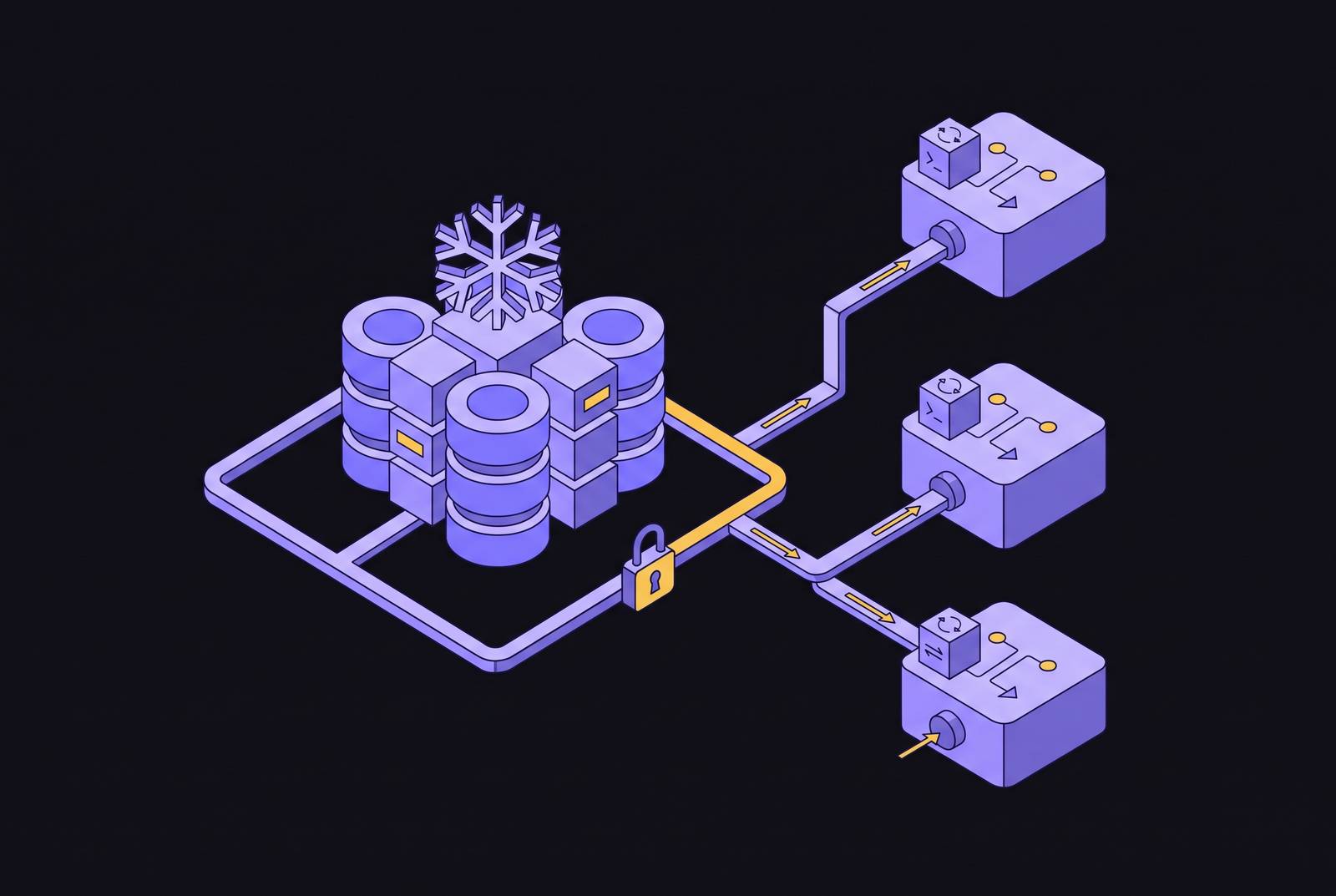
Reliable delivery depends on choosing the right sharing pattern and enforcing tenant isolation in the data model. For customers on other warehouses or destinations, a destination-agnostic integration layer is a separate delivery path.
Why the copy-and-transfer model breaks down for B2B SaaS customer data delivery
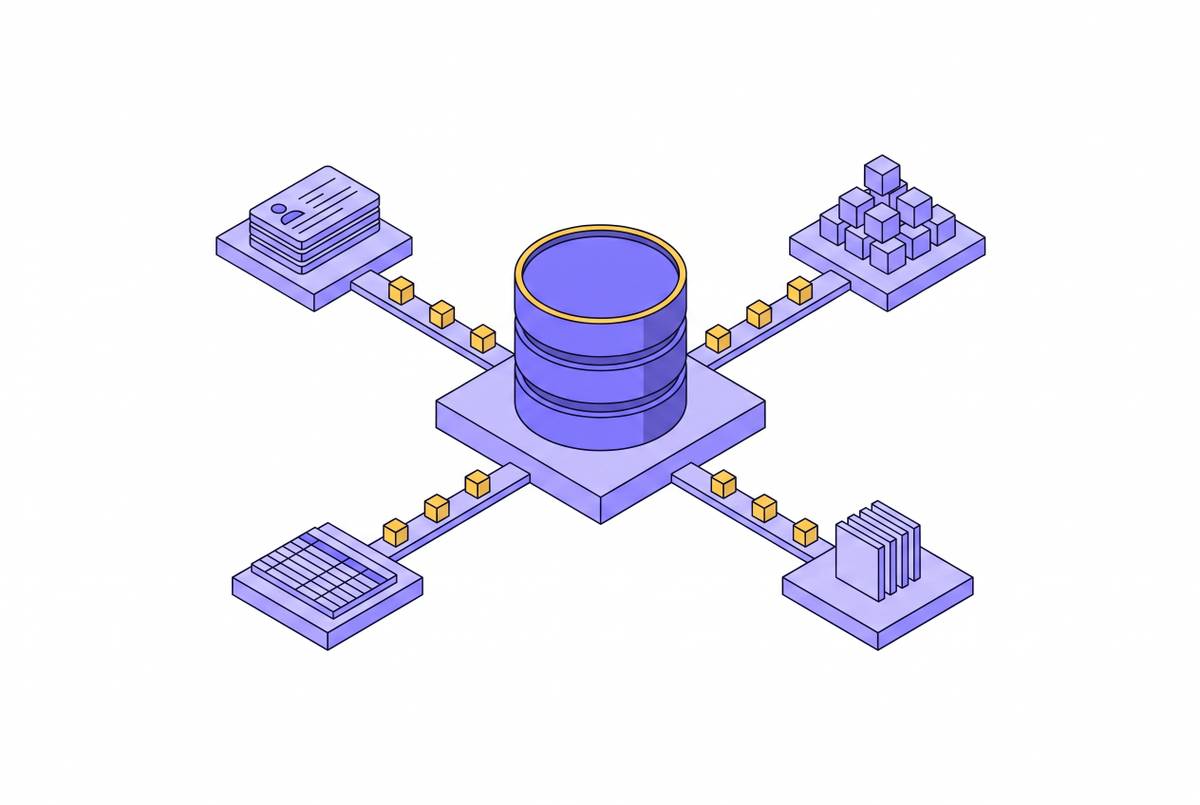
ETL exports, API integrations, file transfers, and bucket syncs all physically move data into a destination system. Their costs are structural. Each copy needs more storage, adds latency, widens the attack surface, and leaves more governance debt as schemas drift. When data crosses a company boundary, changes also mean coordinating work across accounts, clouds, and security teams that lack shared context.
A share instead is a named container of grants. The provider grants access through each database and schema that contains the objects before granting object-level SELECT privileges, then adds consumer accounts and lets each consumer mount the share as a database that points at the provider’s physical objects. QueryPlane’s 2026 walkthrough identifies skipped schema USAGE as the most common first-time mistake, leaving consumers able to see the share but not its tables. The same walkthrough notes that legacy account locators and org-qualified identifiers both work with ALTER SHARE ADD ACCOUNT, but recommends the org-qualified form because it survives account renames and physical moves. With no copy, an inserted row is visible on the next query, without propagation delay, copy drift, or consumer-side schema migration. The provider pays for the underlying storage and consumers pay for query compute, but direct shares work only within the same cloud and region, and consumers cannot use INSERT or UPDATE on shared objects.
Three delivery patterns B2B SaaS teams actually choose between
Direct shares are the simplest operational choice for one-to-few relationships with customers already on Snowflake in the provider’s cloud and region. The provider explicitly lists each consumer account, and the consumer creates a database from the share. Geography is the binding constraint for global deployments. A direct share suits a small, co-located customer base, but it cannot by itself serve an account in another region or cloud.
Private listings add a distribution model around the data. They support versioning, letting providers iterate share contents and consumers receive updates on their next query, as well as attribute-based access controls that can auto-approve consumers whose email domains match an allow-list. Listings also provide the vehicle for cross-cloud and cross-region auto-fulfillment. That reach changes the economics of delivery. Auto-fulfillment replicates data into the consumer’s region, reintroducing storage and egress costs that teams should price before committing, especially for large event streams distributed globally.
Reader accounts serve customers who do not have Snowflake accounts of their own. The provider creates and manages an account on the customer’s behalf and pays its compute costs, unlike the standard consumer-funded query model. Governance also remains entirely with the provider. This makes reader accounts the most operationally demanding of these three choices and a poor fit as customer count grows. None of the three patterns, however, automatically separates one tenant’s rows from another’s.
How multi-tenant data isolation works inside a single share
A SaaS provider can hold many customers’ data in one Snowflake account, but sharing access does not establish tenant boundaries. One approach assigns each customer a separate share scoped to that customer’s data. The share count then grows with the customer count. That approach makes isolation explicit through separate delivery objects, at the cost of maintaining them as the business expands.
Secure views are the recommended way to do this inside a single share. They filter rows according to the querying consumer’s context without exposing the underlying table structure. Unlike regular views, secure views hide the view definition and query plan, preventing consumers from inspecting how the filter is constructed or reverse-engineering other tenants’ data. The boundary belongs in the semantic layer. Row, column, and field-level security defined in the model can then apply to every query rather than depending on the route through which a request arrives.
The application-layer failure mode is concrete. If tenant filtering exists only in middleware, an agent that constructs a query outside the middleware’s anticipated paths can reach data the user interface would never surface. A restricted screen is not a restricted data model. When the model enforces the tenant filter, AI-generated queries are bound by that filter without depending on how the application behaves.
A white-label integration layer can handle pipelines for customers using other warehouses, databases, or object storage, or support branded delivery without requiring customers to log in to Snowflake directly. That separates the product surface from connector maintenance. Openflow’s Bring Your Own Cloud deployment runs the integration within the customer’s environment, initially in AWS commercial regions and inside the customer’s VPC. Where the integration runs and which rows a tenant can see are different boundaries, so tenant filtering is still needed wherever it runs.
The Native App Framework as an alternative delivery model for installable data products
The Native App Framework changes what the provider delivers. Rather than exposing data alone, an app installs in the consumer’s Snowflake account and can combine shared data objects with Snowpark procedures and Streamlit interfaces. The provider controls what consumers can see and do without exposing the underlying implementation. A raw share is the wrong primitive when the product must include computation, business logic, or a user interface.
My Data Outlet (MDO) used this approach to deliver data to hedge funds and asset managers. MDO reported that it “facilitates smooth delivery to our customers without the need for extensive coordination with clients' various departments,” and reached significant ARR within a year of launching its Snowflake Native App. Native Apps still need consumers to use Snowflake and are harder to build than direct shares or private listings. They suit products that need governed interactivity, and all three sharing patterns and the app model still need security governance.
Security governance for shared data: what the access model actually enforces and where it does not
Providers use role-based access controls to decide who can see what and can limit shares to specific objects within a schema. Audit logs provide visibility into who queried what and when. AWS PrivateLink, Azure Private Link, and Google Cloud Private Service Connect support private connectivity, which keeps data off the public internet. These controls address different parts of access.
Those capabilities do not correct an over-permissioned configuration. Common weaknesses include role sprawl, privilege escalation through functional role inheritance, and shares or reader accounts that grant access to more than they need to. Share creation is a particularly consequential permission. Too many roles able to create a share without a second approval create a short path from a legitimate analyst credential to unintended exposure.
Independent certification, such as SOC 2 Type 2, and private-cloud or VPC-based deployment of the integration layer are increasingly requirements. The integration layer is part of the assessment. A private warehouse connection alone does not answer where the delivery pipeline runs or which provider controls govern it.
How AI agents change the data access model and what Snowflake has built for it
AI agents make governed query access a product capability. Their ability to construct queries changes what providers can safely assume about the path from a user request to shared data. Interface restrictions cannot define the authorization boundary. The semantic-layer controls described earlier therefore become a prerequisite for exposing shared datasets to agents.
Cortex Sense, entering private preview in mid-July 2026, improves accuracy on its benchmark by grounding agents in metadata and query history. A more reliable query still needs an authorized scope. For SaaS providers, that distinction permits shared data to underpin AI-powered product experiences without treating improved accuracy as a security control. The governance architecture is therefore not just a compliance exercise, but what makes agent access safe to enable.
The strongest objection: lock-in and shared-responsibility confusion
Snowflake sharing creates a real destination dependency. If a customer leaves Snowflake, zero-copy delivery no longer works for that customer, and a provider that relies on sharing alone must build another path, perhaps under pressure to meet its contract. This objection is less decisive for Snowflake-native customers. They have already made their own platform choice, so a share fits their existing environment.
A destination-agnostic integration layer can support other warehouses, databases, and object storage while retaining Snowflake sharing where it fits. Sharing becomes one output within the delivery strategy. This approach addresses the single-destination dependency without discarding the benefits of metadata-pointer delivery for customers able to use it.
Snowflake secures the platform, while the provider decides what is shared, how narrowly it is scoped, and how roles are configured. Enterprise security teams can assume the platform provider owns more of this responsibility than it does, causing disagreement late in a sale. The recommended response is explicit pre-sale documentation. Mapping provider and platform responsibilities to the customer’s compliance framework makes the boundary part of the purchase decision.
Choosing the right delivery pattern: a decision framework for B2B SaaS teams
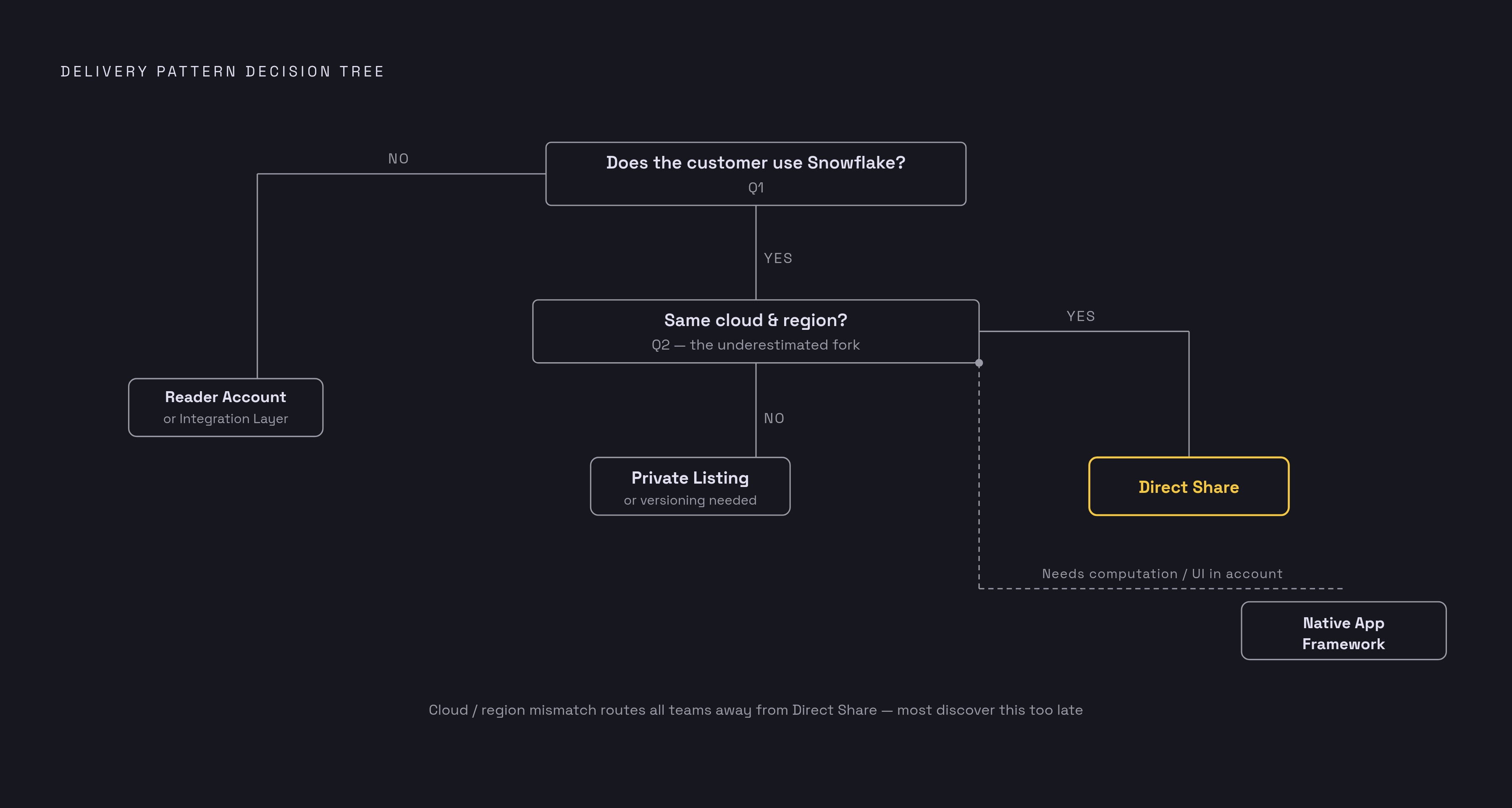
The choice starts with the customer’s data environment, how many customers need the same data, and how much governed interactivity the product needs. If a small number of customer accounts already use Snowflake in the same cloud and region, a direct share fits. If customers span clouds or regions, or the provider needs distribution to many accounts, versioning, or attribute-based access, a private listing fits instead. Auto-fulfillment is conditional. Its storage and egress costs need pricing before global enablement.
If the customer does not use Snowflake, the choice turns on whether a provider-managed reader account is acceptable or delivery must reach the customer’s existing destination. A reader account places compute and governance on the provider. An integration layer instead handles delivery to the required environment. For a mix of Snowflake, other warehouses, databases, and object storage, a destination-agnostic layer avoids making the whole product dependent on Snowflake sharing.
If the product requires computation, business logic, or a user interface inside the customer’s Snowflake account, the Native App Framework fits better than a raw share. If agents will query the product, semantic-layer isolation must govern their access from the start, however the product is packaged. Query accuracy and tenant authorization remain separate acceptance criteria.
Before any share goes live, the implementation requirements are the same. The team must define a model scoped to each customer’s needs, implement secure views with row-level and column-level filters, audit the role hierarchy for excessive share-creation rights, and document the shared-responsibility boundary for procurement. Where an integration layer is involved, its deployment and security posture also belong in that decision. The mechanism is well-documented. Teams ship it reliably when they choose the delivery pattern before building.