Snowpipe vs Snowpipe Streaming for Near-Real-Time Ingestion
Snowpipe Streaming pushes rows directly; Snowpipe pulls files—fundamentally different architectures.

Both products carry the Snowpipe name, and that naming is the first thing that misleads teams evaluating Snowflake ingestion options. Treating Snowpipe and Snowpipe Streaming as two points on a single latency dial, with one just faster than the other, is a category error that leads teams to pick the wrong architecture before they've even written a line of ingestion code. Snowpipe is a file-pull system: it watches cloud storage, in S3, GCS, or ADLS, for new files, picks up an event notification when one lands, queues the file, and runs a COPY INTO operation through serverless compute. Snowpipe Streaming is a row-push system: the client application sends rows directly through a channel to a target table, with no staging area, no intermediate files, and no COPY INTO step. The two systems differ in how ingestion gets triggered, what unit of data moves through the pipe, how much delay sits between write and query, how the bill gets calculated, and what guarantees you get about whether a row made it in exactly once or possibly more.
How Snowpipe's file-based pipeline works
Snowpipe's pipeline runs through several discrete steps, and each one adds its own slice of delay, so sub-minute ingestion is structurally out of reach for this tool no matter how you tune it. An application or ETL tool writes a file to cloud storage. The storage service fires an event notification, through SQS on AWS, Pub/Sub on GCS, or Event Grid on Azure. Snowpipe dequeues that notification, serverless compute executes a COPY INTO command, and only then does the data become queryable. If you set AUTO_INGEST to TRUE, Snowpipe listens for these event notifications automatically, and a typical pipe definition looks like this:
CREATE PIPE my_pipe AUTO_INGEST = TRUE AS
COPY INTO my_table
FROM @my_stage
FILE_FORMAT = (TYPE = 'JSON');
Without AUTO_INGEST, you have to trigger ingestion manually through the insertFiles REST API, and most teams would rather avoid that operational overhead. The minimum end-to-end latency for this pipeline is around 60 seconds, but in practice it can stretch to several minutes depending on queue depth and file size. The "near-real-time" label sometimes attached to Snowpipe is misleading for any workload where seconds actually matter. Deduplication happens at the file level, keyed to filename: upload a file with the same name twice and the second copy gets skipped, but there's no row-level deduplication or cross-file ordering guarantee built in. File format shapes the outcome too: CSV loads every field as a string unless you cast it manually, while JSON and Parquet carry richer type inference and handle schema evolution far more cleanly.
How Snowpipe Streaming's row-push pipeline works
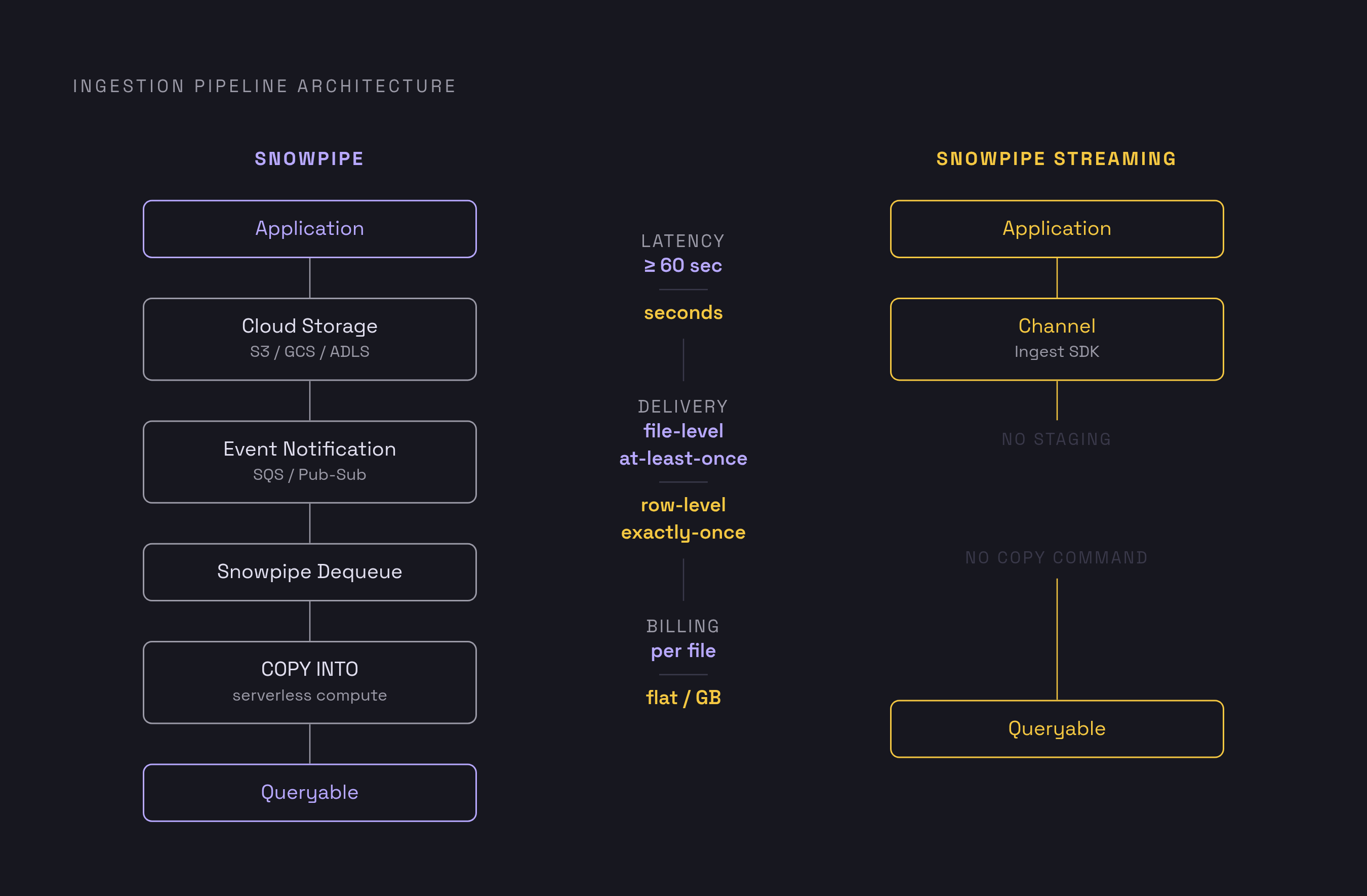
Snowpipe Streaming removes the staging layer. The client pushes rows through a channel straight into a target table, and those rows become queryable within seconds. An application or a Kafka connector opens a channel to a target table using the Ingest SDK, sends rows through that channel, and the rows are queryable seconds later, with no intermediate files, no staging tables, and no COPY command anywhere in the sequence. The delivery guarantees are meaningfully stronger than Snowpipe's: exactly-once delivery per stream channel, assuming proper offset tracking, with row order preserved within each channel, compared against Snowpipe's at-least-once, file-level guarantee.
The high-performance architecture is a ground-up redesign of this pipeline, not an incremental patch. It reached general availability on AWS in September 2025, then on Microsoft Azure in November 2025. Schema validation happens server-side now, so you no longer face the heavy client-side processing load the classic architecture required. The Java and Python SDKs run on a shared Rust core, and a REST API is also available for lightweight or serverless ingestion workloads that don't need a full SDK integration. The cost model changed along with the mechanics: one flat rate charged per uncompressed GB ingested, replacing the per-file overhead charges that made cost prediction harder under the older model.
What the architectural gap looks like at production scale
The advantages of row-push ingestion compound as volume grows, in ways that file-pull architecture simply cannot match, and two production cases make that concrete. Cboe Global Markets, the exchange operator, needed to replace a legacy system built on proprietary wire protocols and end-of-day batch ETL so internal teams could get near-real-time access to market data. Running on the high-performance architecture, Cboe now processes over 100 TB of uncompressed data daily, and its internal analytics hit a P95 query latency under 30 seconds. Appian, the AI process automation platform, migrated to the high-performance architecture to replace an ingestion pipeline that was rigid and code-heavy. Appian decoupled its table structure from its ingestion logic by managing pipes through Terraform, a change that stayed transparent to the Java application sitting on top of it; its ingestion engine, internally called "Snowblower," now handles close to half a petabyte of log data every month across dozens of regions.
Both cases point to the same underlying pattern. The file-based pipeline doesn't just fall behind on latency at this scale, it becomes a drag on engineering flexibility: schema coupling, region sprawl, and operational overhead all grow together as file-pull architecture strains under volume that row-push handles natively.
The trade-offs that don't disappear with the new architecture
The high-performance architecture closes a lot of gaps, but Snowpipe Streaming still carries structural trade-offs, and teams need to plan for them ahead of time, not discover them after launch. Neither tool handles UPSERTs natively. Both Snowpipe and Snowpipe Streaming are predominantly append-only, so deduplication, updates, and deletes all require downstream logic that engineering teams have to build and maintain themselves, which is a real burden for anyone running CDC pipelines inside a SaaS product.
Streaming data also isn't optimized the moment it lands. Rows arrive in micro-partitions that aren't ideally clustered, so you take a query efficiency penalty until Snowflake's background compaction process catches up, and that matters if you need low-latency writes and fast analytical reads at the same time. Schema management stays manual unless you pair a Kafka connector with a schema registry that can auto-add new fields. For SaaS data sync products where source schemas shift without warning, this is an ongoing operational cost. Observability lives entirely on the client side: the Kafka connector exposes metrics, but the SDK itself requires custom logging, with no centralized observability included out of the box, which places the instrumentation burden on whatever team is embedding streaming into a multi-tenant product.
Snowpipe Streaming was never built to replace Kafka. Kafka and Flink remain the better choice for sub-second event routing, and Snowpipe Streaming's second-level latency window, while excellent for analytics, doesn't reach millisecond-class performance. In most architectures the two complement each other. On the Snowpipe classic side, loading thousands of small files drives costs up quickly, so if you run that pipeline, file batching is a practical requirement, not an optional tuning step.
Matching ingestion architecture to use-case requirements
The choice between Snowpipe and Snowpipe Streaming comes down to three variables: the form the data arrives in, the latency the use case genuinely needs, and the delivery guarantees that downstream consumers depend on.
Snowpipe is the right choice when data arrives as files, whether that's SaaS exports, batches of application logs, ETL tool outputs, or scheduled file drops from external systems. It also fits when minute-level latency is acceptable and the workload doesn't demand true real-time freshness, and when the team would rather get automated ingestion without taking on the management of a streaming SDK or a channel lifecycle. Parquet or JSON should be the default format choice here, since both handle type inference and schema evolution more cleanly than CSV.
Snowpipe Streaming is the right choice when data is event-driven, coming from Kafka topics, CDC off operational databases, IoT sensor streams, or clickstream events. It fits when second-level latency actually matters for the use case, as it does for fraud detection, live dashboards, real-time personalization, and context-aware AI agents, and it matters when row-level ordering and exactly-once delivery within a channel are necessary for downstream correctness. It also tends to be the more predictable cost choice at large, continuous volume, because the flat per-GB rate avoids the per-file billing swings that Snowpipe classic can produce.
None of this requires standardizing on one tool across an entire system. Hybrid architectures are common in production: Snowpipe handles scheduled file-based workloads while Snowpipe Streaming handles event-driven workloads in parallel, with each ingestion method matched to what its own pipeline actually needs.
SDK and API maturity for teams embedding this in a product
The implementation cost of Snowpipe Streaming has dropped a lot as its SDK ecosystem has matured, but real gaps remain if you're building multi-tenant or embedded data products on top of it. SDK v1.2.0, released in February 2026, added support for encrypted key-pair authentication. SDK v1.5.0 added support for running inside Snowpark Container Services, where the SDK can read workload identity tokens automatically, so you don't need to store long-lived credentials inside the container.
For a product team building a SaaS data sync feature that needs to embed row-level streaming into its own application, the infrastructure burden of integrating the Snowpipe Streaming SDK directly can still add up fast: client-side schema management, channel lifecycle across potentially hundreds of customers, offset tracking, and the custom logging needed just to get basic observability. A white-label data integration platform like Prequel abstracts that complexity away entirely, handling the client-side ingestion logic, exactly-once delivery guarantees, and schema evolution behind the scenes, so a team can offer its customers fast data ingestion without building and maintaining a custom pipeline for it.
Where Prequel fits for product teams needing Snowflake connectivity
If your core value as a SaaS product team isn't data pipeline infrastructure, the better answer to the Snowpipe versus Snowpipe Streaming question is often to avoid building either one in-house. Prequel is a white-label data integration platform that handles data export and import into customers' Snowflake accounts, along with more than 20 other warehouse, database, and object storage destinations, as an embeddable product feature. It supports high-volume row delivery to destinations on a frequent recurring schedule, and it ships with an embeddable React SDK and a clean API, so an engineering team can ship the connectivity feature without its developers needing to become Snowpipe Streaming SDK experts themselves. Pricing is destination-based with no data-transfer fees, so the cost model stays predictable as your customer data volumes grow. Prequel is SOC II Type 2 certified and end-to-end encrypted, and you can opt for private-cloud deployment if you have data residency requirements, so you get the security posture enterprise buyers tend to require. Synced data also stays accessible to AI agents, so you can build the kind of data-driven, AI-powered product experiences that depend on fresh warehouse data.
At the scale Cboe and Appian operate, the performance gains from row-push ingestion compound, but so does the operational complexity of managing SDKs, delivery guarantees, and schema validation across distributed clients. For SaaS platforms that want to offer customers Snowflake ingestion as a native feature, embedding a purpose-built data connectivity layer removes the need to build and maintain that plumbing in-house; Prequel, for instance, handles the SDK instrumentation, monitoring, and compliance burden so the product team can stay focused on its own application logic.
The teams best served by this path are the ones running into the UPSERT gap, schema drift, multi-tenant channel management, and observability instrumentation described earlier, problems that are built into Snowpipe Streaming's architecture and that a platform like Prequel absorbs on their behalf. If your team has strong data engineering capacity, a single-tenant deployment model, and highly specific ingestion logic, you're generally better off building directly on the Snowpipe Streaming SDK, because Prequel isn't the right tool for every case. What stays constant either way is that the architectural choice between Snowpipe and Snowpipe Streaming is real and consequential, and so is the separate choice of whether to build that pipeline or embed it.