Zero-Pipeline Redshift Ingestion Patterns for Multi-Source Enterprise CRM and Product Data
Combine AWS-native replication with embedded SaaS exports to ingest multi-source enterprise data.
Enterprise customer data export without custom pipelines needs an architecture built for each source, with more than a single zero-ETL tool. AWS-native zero-ETL fits supported transactional sources feeding Redshift, while embedded connectivity lets SaaS products offer customer-configured warehouse exports. For multi-source CRM and product data, the durable approach combines these patterns and applies governance at the destination.
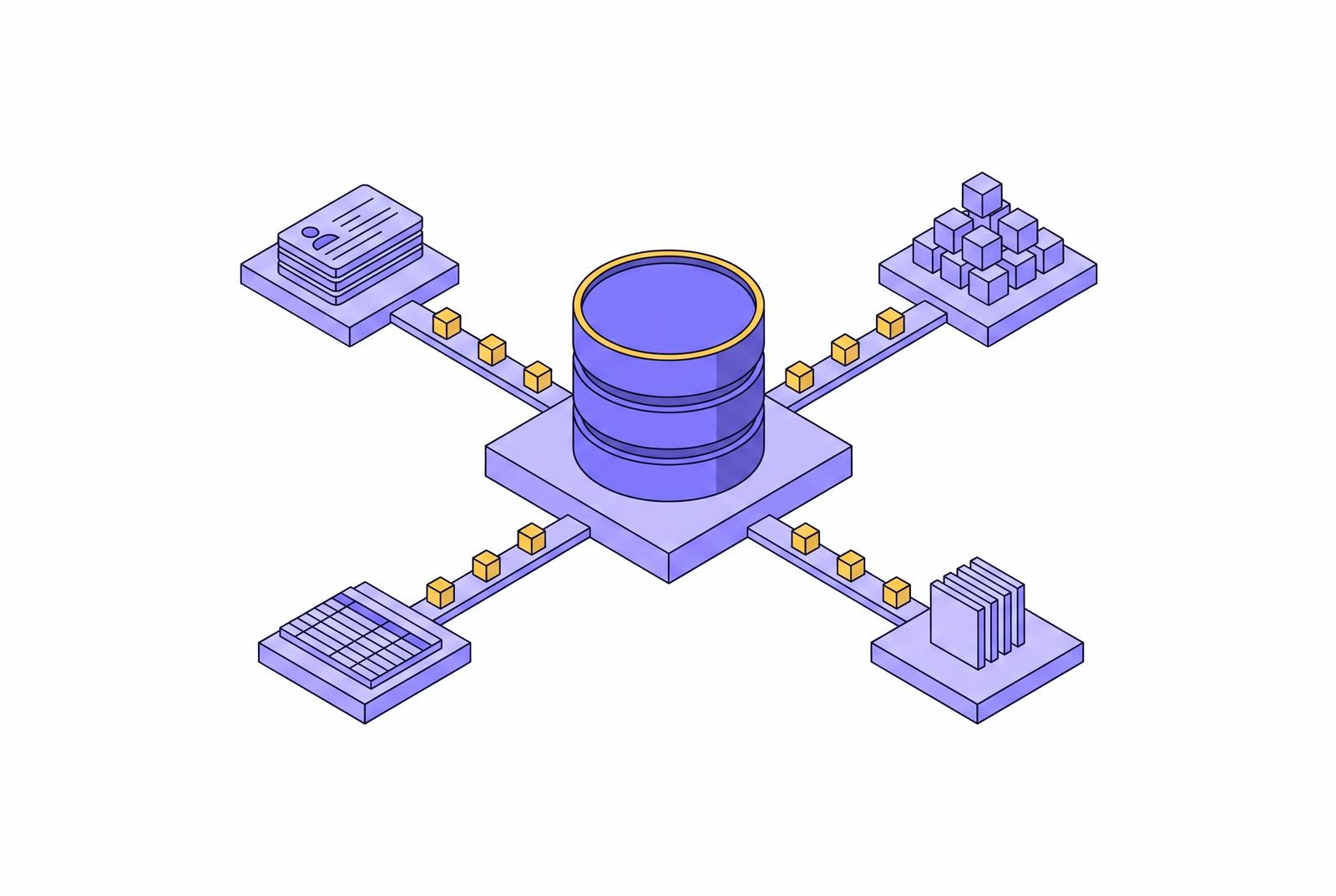
For AWS-managed databases such as Aurora and RDS, AWS-native zero-ETL integration replicates data into Redshift automatically, with no customer-maintained extraction job or staging step. SaaS CRM data from systems like Salesforce and HubSpot, and product event data held in third-party platforms, require a separate approach: embedded data connectivity, where the SaaS product itself exposes a customer-configured export capability that handles authentication, schema mapping, and rate limiting without a bespoke connector project. Glue-brokered integrations cover a middle tier, including Salesforce, SAP, ServiceNow, and Zendesk, as managed routes within the AWS service boundary, though they do not behave identically to a direct Aurora integration. The durable multi-source architecture combines these patterns in parallel, one for each source category, with schema contracts, masking, and quality policies applied at the Redshift destination.
Why Redshift ingestion still demands a pattern choice, even in a zero-ETL world
An enterprise workload can combine transactional databases, SaaS CRMs, product event streams, and object storage, each with different ingestion requirements. A service that replicates operational tables does not automatically solve application authentication, tenant isolation, or changing event schemas. Those are separate engineering obligations. The practical decision therefore happens at the source level, even when the procurement conversation treats zero-ETL as one category. Choosing an ingestion pattern means deciding which obligations a provider assumes and which remain with the enterprise.
Teams can adopt zero-ETL where it fits, stretch the same assumptions across other sources, and accumulate replicated tables without schema contracts, masking, or clear ownership. Data movement succeeds while analytical trust remains unresolved. A wrong number in an executive report can expose that gap long after the integration appears operational. The taxonomy must therefore separate managed replication from other ways of delivering data, since cutting connector code can lead to different architectures.
What AWS zero-ETL actually is — a managed replication service, not an absence of infrastructure
AWS Redshift documentation defines zero-ETL integration as a fully managed solution that automates the creation and management of replication from a source into Redshift. The customer does not maintain the ETL pipeline. AWS operates that pipeline within its service boundary, with the associated infrastructure dependency and billing relationship. Source systems can continue serving updates and queries while Redshift serves analytical workloads.
Conceptually, this is automated ELT: source data arrives in Redshift as-is, and transformations happen afterward in the warehouse. The team still has to do the modeling. Data quality work and the semantic layer also remain necessary because replication does not establish what a field means or whether it is suitable for reporting.
Pionex's 2026 experience reported significant reductions in deployment and maintenance costs and in the workload required to create pipelines. Those savings concern real engineering work. They do not eliminate the need to configure and operate the surrounding AWS services. The required skills shift toward RDS/Aurora, Glue, Redshift, IAM, Lake Formation, KMS, and EventBridge monitoring. In practice, the team exchanges connector maintenance for service configuration and downstream data management, so an evaluation must account for both sides of that exchange.
The AWS-native source matrix — where zero-ETL works without compromise
The strongest fit occurs when AWS controls both ends of the integration. That boundary gives the native pattern its coherence. The documentation lists Amazon Aurora MySQL, Amazon Aurora PostgreSQL, Amazon DynamoDB, Amazon RDS for MySQL, Amazon RDS for Oracle, Amazon RDS for PostgreSQL, and Oracle Database@AWS as supported sources. It also includes self-managed MySQL, PostgreSQL, SQL Server, and Oracle. However, inclusion in the same source matrix does not mean that every source uses the same replication path.
The documentation includes Salesforce, Salesforce Marketing Cloud Account Engagement, SAP, ServiceNow, Instagram ads, Meta ads, and Zendesk through AWS Glue. The self-managed database path also uses Glue, with DMS providing the capture layer. These are brokered integrations within the AWS service boundary. Their presence extends the source matrix, but it does not make them operationally identical to a direct Aurora integration.
The Aurora zero-ETL page describes transactional data becoming available in Redshift within seconds of being written to Aurora. There is no customer-maintained extraction job, staging step, or hand-written connector. Intuit, whose products include TurboTax, Credit Karma, QuickBooks, and Mailchimp, faced more than 10 million profile migrations per day. It used Aurora MySQL zero-ETL to remove data capture jobs and separate ingestion steps, which saved months of engineering work and let it run near-real-time migration analytics.
MassPay uses Aurora MySQL as the operational backbone for payout workflows spanning billions of dollars in processing. Zero-ETL enabled near-real-time reporting on payout performance and customer trends. Infosys applied the pattern to freight tracking and retail analytics, replicating Aurora data into Redshift and reducing QuickSight dashboard delivery time from hours to seconds. KINTO Technologies, Toyota's mobility services technology arm, replaced a custom-built CDC streaming solution that had persistent performance challenges with Aurora MySQL zero-ETL. Its result was a more resilient pipeline with near-real-time operational data available for Redshift analytics.
Where the AWS-native pattern reaches its limits — SaaS CRM and heterogeneous product data
The direct Aurora model needs a tightly controlled relationship between the source and the destination. Heterogeneous SaaS data does not share that relationship. Salesforce is in the supported source matrix through Glue. A brokered application integration belongs to the zero-ETL service category, but it is not the direct, seconds-latency replication path that Aurora provides.
SaaS CRMs such as Salesforce and HubSpot do not offer an equivalent Aurora-to-Redshift path. For applications it supports, Glue offers a separate managed route that works in its own way. Clickstreams, feature usage, and session data held in third-party systems introduce schema drift, API rate limits, and multi-tenant isolation requirements. Native database replication alone does not address that combination of application and product obligations.
Consequently, a workload mixing Aurora operational records, Salesforce CRM data, and SaaS product usage cannot be evaluated as one uniform integration. It needs approaches that run side by side, with different latency profiles, ways they can fail, and governance requirements. This is not evidence that managed replication has failed. The architecture needs a complementary pattern for sources whose export behavior is controlled by the SaaS product.
How do you ingest data into Redshift from multiple sources like CRM and product events without building custom ETL pipelines?
Embedded data connectivity makes warehouse export a feature of the product, taking the place of a separate infrastructure project that each customer runs. A SaaS team adds an SDK or API surface through which customers configure secure exports of their own data to their own Redshift warehouse or another supported destination. The connectivity layer handles authentication, schema mapping, rate limiting, and export. Engineering work shifts into a reusable product integration. It does not require a bespoke connector infrastructure project for every enterprise customer.
This pattern complements AWS-native replication because it addresses a different control boundary. The SaaS product exposes the export capability, while the customer configures the destination. In the direct-export model described here, there is no intermediate staging or shared data store, and the vendor does not retain data in transit longer than necessary. With these properties, the product goes beyond putting an interface on a pipeline that the customer runs. They also make the product layer responsible for providing a usable, secure export experience.
Multi-tenancy is the decisive stress test for this design. One customer's export spike must not degrade another tenant's data availability. Platforms built for multi-tenancy by construction address that requirement as part of their architecture, rather than treating embedding as a later interface addition. A white-label layer with an embeddable React SDK and a clean API can let a SaaS team reduce the time to ship Redshift export from quarters to days. That implementation advantage is valuable only if the underlying platform also meets the isolation requirement.
Pricing belongs in the architectural comparison as well. Enterprise customers may often move millions of rows, so per-row or per-transfer charges rise with the very workloads the feature is built to serve. Destination-based pricing aligns cost with configuration. For buyers seeking exports to other data warehouses as well as Redshift, destination support remains a separate selection criterion. AWS-native replication into Redshift and customer-configured warehouse export should not be treated as interchangeable capabilities merely because both reduce custom pipeline maintenance.
Security and compliance requirements that apply across both patterns
Removing a custom pipeline can also remove an unnoticed governance stage. An intermediate schema may have been where a team filtered sensitive fields or applied masking before loading the warehouse. That control point does not survive automatically. When managed replication replaces it, governance must move into the destination, with explicit policies established before the data becomes queryable.
The documentation states that customers control encryption at the integration source, at the integration itself, and at the Redshift warehouse. Each layer requires an explicit configuration decision. For private connectivity, AWS PrivateLink can connect sources and Redshift through endpoint services, target groups, a Network Load Balancer, and security groups without exposing public endpoints. The described path requires both the source tool and Redshift cluster to be hosted on AWS, so it is not a cross-provider solution.
Embedded connectivity also has to meet the compliance requirements on the ingestion side. Enterprises need at least SOC II Type 2 certification and end-to-end data encryption. Residency requirements can impose a further deployment constraint. Customers that cannot let data pass through shared infrastructure need the option of private-cloud or customer-VPC deployment. These controls cover how data reaches the warehouse, while destination-side masking and access policies control who can use it once it arrives. Neither layer substitutes for the other.
Choosing the right pattern for each source type — a decision framework for enterprise teams
For AWS-managed databases, including the supported Aurora and RDS engines and DynamoDB, AWS-native zero-ETL is the default. Outside that estate, SaaS and product sources call for embedded connectivity where the product must provide customer-facing exports. Glue-brokered applications occupy a distinct middle position. Salesforce, SAP, ServiceNow, Zendesk, and Meta and Instagram ads may fit that managed route, but their inclusion in the taxonomy should not imply Aurora-equivalent behavior.
Latency is the next decision axis: Aurora-to-Redshift makes data available within seconds, while brokered application paths and embedded platforms have different latency profiles that must meet the needs of the analytics. Near-real-time fraud detection and daily CRM analytics have different tolerances. For an ingestion layer serving multiple enterprise customers, the next test is tenant isolation. Teams should validate that one tenant's load cannot degrade another's availability, rather than accepting an embedded interface as proof of multi-tenant architecture.
Modeling discipline applies after every one of those choices. Raw records require explicit schema contracts, data quality tests, assigned ownership, and masking policies before they are made queryable. The resulting enterprise architecture is commonly hybrid, combining AWS-native zero-ETL for operational sources with embedded connectivity for SaaS CRM and product data, under unified warehouse-side transformation and quality policies. Framing the choice as zero-ETL versus traditional ETL obscures those source-specific obligations. Framing it as the right pattern for each source, with governance at the destination, gives teams a way to eliminate custom maintenance without leaving its unresolved responsibilities elsewhere.